
Bandpass
Bandpass removes details finer than Sigma Small (noise) and structures coarser than Sigma Large (uneven background) and keeps everything in between. Unlike the spot filters (Laplacian of Gaussian, Difference of Gaussians) it is not tuned to one size: objects of different sizes stay.
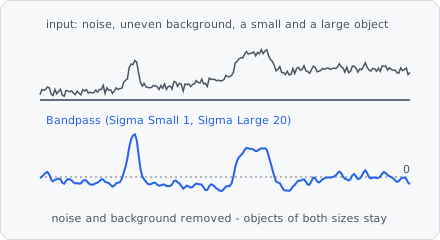
The result is in the image’s intensity units around 0: bright objects positive, the removed background 0 (values can be negative). Follow it with a Threshold or Find Maxima:
Bandpass → Threshold | Find Maxima
It is a preprocessing step: its result replaces the image for the steps after it. Measure intensities on the original channel, not on this image. In a project file it is BANDPASS.
When to use
Section titled “When to use”Use it to flatten an uneven background and reduce noise in one step, before a threshold, when the objects are of different sizes. With Sigma Large 0 it is a plain blur, with Sigma Small 0 a background subtraction. For whole-image illumination differences (vignetting), Illumination Correction is the better tool; for spots of one size, Laplacian of Gaussian.
Parameters
Section titled “Parameters”| Parameter | Description |
|---|---|
| Sigma Small | σ of the narrower Gaussian: details finer than about this are smoothed away (noise). 0: no smoothing. Default 1, range 0-10000. |
| Sigma Large | σ of the wider Gaussian, subtracted: structures coarser than about this are removed (uneven background). Must be larger than Sigma Small; 0: nothing removed. Default 15, range 0-10000. |
| Unit | Unit of both σ: px (default) or nm. Without a pixel size, nm are taken as pixels. |
Choose Sigma Large a little larger than the largest object, so the objects are not removed with the background.
How it works
Section titled “How it works”The result is
with the image smoothed with the discrete Gaussian (Lindeberg 1998, appendix A.4.1). A Gaussian low-pass times a Gaussian high-pass in the frequency domain is the difference of two Gaussians in the image, so no Fourier transform is needed. It is the band-pass that the difference of Gaussians is in Marr & Hildreth (1980, appendix B), here with two independent σ instead of their ratio 1.6. With Sigma Large 0 the second term is left out; with Sigma Small 0 the first term is the image itself.
If Sigma Large is not 0 and not larger than Sigma Small, the band is empty and the step fails with an error.
Limitations
Section titled “Limitations”- 2D only: each plane is filtered on its own.
- On a whole slide the filter runs per tile, mirrored at the tile’s borders like Gaussian Blur. With a large Sigma Large the tile borders can show. Small images are one tile and not affected.
References
Section titled “References”- Lindeberg T., “Feature Detection with Automatic Scale Selection,” International Journal of Computer Vision, vol. 30, pp. 79-116, 1998. doi:10.1023/A:1008045108935
- Marr D. & Hildreth E., “Theory of Edge Detection,” Proceedings of the Royal Society of London. Series B, vol. 207, pp. 187-217, 1980. doi:10.1098/rspb.1980.0020
The step cites both; see Citation for exporting the citations of a project.