
Track LAP
Track LAP links the objects of a time-lapse into tracks by the globally best assignment, for objects moving at random (Brownian motion). It closes gaps - an object missed by the segmentation in a frame or two - and, if switched on, detects merges (e.g. vesicle fusion) and splits (e.g. cell division). Every tracked object gets a Track ID, shown as a column in the results.
It is a dataset step: it runs once after every image has been analysed, on the stored objects of all frames.
The tracks it makes are shown in Results › Tracks: a row per track with its time points - and, with a Measure Track Motion step after it, how far it moved, its speed and straightness -, its trail on the image and - with merges and splits - its parent and child tracks.

Parameters
Section titled “Parameters”| Parameter | Description |
|---|---|
| Object Class | The object class to track. |
| Unit | Unit of the distances: nm (default) or px. |
| Max Distance | How far an object may move from one frame to the next - also the farthest a merge or split partner may be. Default 10000. |
| Max Gap Frames | How many frames in a row an object may be missing and its track still continue. 0: no gap closing. Default 2, range 0-100. |
| Max Gap Distance | How far an object may move while it is missing. Default 15000. |
| Merging | Detect two objects merging into one (e.g. vesicle fusion). Off by default. |
| Splitting | Detect one object splitting into two (e.g. cell division). Off by default. |
| Merge Split Amount | (advanced) What a merge adds up and a split divides: Area or Intensity (default Area) - see Merge Split Amount. |
| Channel | (advanced) The channel of the intensity, if Merge Split Amount is Intensity. |
With an impossible value the step stops with an error: The maximum distances must be greater than 0.
How it works
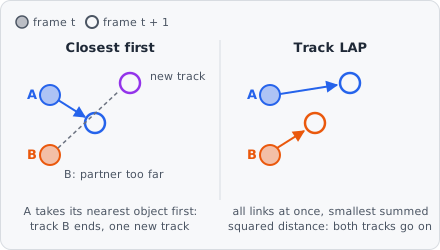
Section titled “How it works”Per image and Z-plane, tracking runs in two steps, both solved as a global linear assignment problem (Jaqaman et al., 2008), so every link competes with all others instead of being taken closest first:
- Frame to frame: the tracks ending in frame t are linked to the objects of frame t + 1 so that the summed cost is smallest, each object once. A link costs the squared distance between the two objects; objects more than Max Distance apart are not linked.
- Gaps, merges and splits: a track’s end is linked to another track’s start up to Max Gap Frames missing frames later (gap closing). With Merging, a track’s end can also run into the middle of another track in the next frame; with Splitting, a track’s start can come out of the middle of another one in the frame before. Merges and splits cost the squared distance times a penalty for how well the amounts add up (equations 5 and 6 of the paper) - see Merge Split Amount.
Not linking costs 1.05 times the highest cost a link may have, so any possible link beats no link, and the links only compete with each other.
What the links make of the tracks:
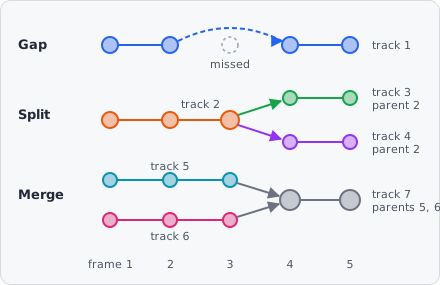
- A closed gap continues the track.
- A merge ends both tracks and starts a new one, with both as its parents.
- A split ends the track and starts two - its continuation and the new object - each with the old track as parent.
The parents are stored with the tracks and shown in Results › Tracks as lineage (divisions and fusions). Positions are the centres of the objects’ bounding boxes. Track IDs are unique across tracking steps: a second tracking step for another class continues after the IDs the first one gave. Objects that are not tracked have no Track ID.
Merge Split Amount
Section titled “Merge Split Amount”A merge adds two objects up and a split divides one - Merge Split Amount says what, to tell a true merge or split from objects that only pass close by:
| Merge Split Amount | For |
|---|---|
| Area | Objects that keep their size (e.g. cells). |
| Intensity | The summed intensity of Channel (mean × area): for spots below the resolution limit (e.g. vesicles), whose brightness adds up but whose size doesn’t. |
References
Section titled “References”- Jaqaman K. et al., “Robust single-particle tracking in live-cell time-lapse sequences,” Nature Methods, vol. 5, pp. 695-702, 2008. doi:10.1038/nmeth.1237
- Jonker R. & Volgenant A., “A shortest augmenting path algorithm for dense and sparse linear assignment problems,” Computing, vol. 38, pp. 325-340, 1987. doi:10.1007/BF02278710
Limitations
Section titled “Limitations”- Only project classes can be tracked, not the internal classes of a module.