
Random Forest
Random Forest is one of three algorithms selectable in the Train Classifier dialog, for both pixel and object classifiers. It’s an ensemble of many independent decision trees, each trained slightly differently, whose predictions are combined by majority vote.
How It Works
Section titled “How It Works”A single decision tree classifies a sample by asking a sequence of yes/no questions about its features - “is Circularity < 0.4?”, “is Gaussian-Blur(σ=2) intensity > 0.6?” - branching left or right at each one until it reaches a leaf, which holds a predicted class. Trained alone, one tree tends to overfit: given enough splits, it can carve out a rule for every quirk of the training data, including its noise.
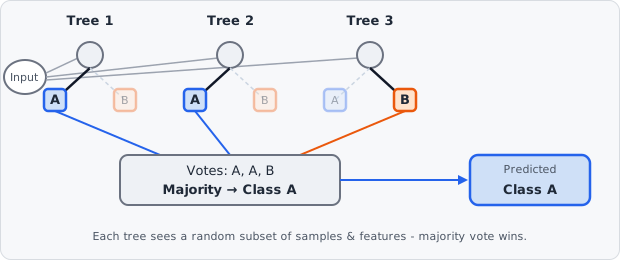
A Random Forest trains many such trees and lets them disagree:
- Each tree sees a different bootstrap sample - a random subset of the training rows, drawn with replacement.
- At each split, each tree considers only a random subset of the available features, not all of them (Features per Split below).
Because every tree is trained on different data and different feature subsets, they make different mistakes. Averaging their votes cancels out most of that noise - a technique called bagging (bootstrap aggregating). To classify a new pixel or object, every tree in the forest votes for a class, and the forest predicts whichever class gets the most votes.
Configuring in EVAnalyzer
Section titled “Configuring in EVAnalyzer”| Parameter | Description |
|---|---|
| Number of Trees | How many trees make up the forest. More trees give a steadier vote but cost more at both training and inference time |
| Max Tree Depth | Maximum depth any single tree may grow to. 0 = unlimited. A deeper tree can fit finer distinctions, at higher overfitting risk |
| Min Samples Split | A node needs at least this many samples before it’s allowed to split further |
| Min Samples Leaf | A split is only kept if both resulting leaves end up with at least this many samples |
| Split Criterion | How a split’s quality is scored - Gini impurity or Entropy (information gain); both usually give similar trees |
| Features per Split | How many features each split may consider. 0 = automatic (√ of the total feature count) - the randomness that keeps trees decorrelated |
| Random Seed | Seed for the bootstrap sampling and feature selection, so the same settings reproduce the same forest |
| Estimate accuracy from out-of-bag samples | Each tree’s bootstrap sample leaves roughly a third of rows unseen (“out-of-bag”) - scoring the tree against those gives a built-in accuracy estimate without needing a separate held-out set |
When to Choose It
Section titled “When to Choose It”Random Forest is a good first try for most pixel and object classifiers: it’s insensitive to feature scale (no need to normalize Gaussian-blur output against raw intensity), tolerates noisy or redundant feature channels well (an uninformative feature just doesn’t get picked at many splits), and needs very little hyperparameter tuning to get a reasonable result. Its main limitation is the inference-time cost discussed above - if a forest large/deep enough to be accurate is also too slow to run over every pixel of your images, consider k-Nearest Neighbors or a Neural Network instead.