
Neural Network (MLP)
Neural Network (MLP) is one of three algorithms selectable in the Train Classifier dialog, for both pixel and object classifiers. It’s a small feed-forward multi-layer perceptron - the same family of model behind most modern deep learning, just with far fewer layers - trained from scratch on your labeled examples.
How It Works
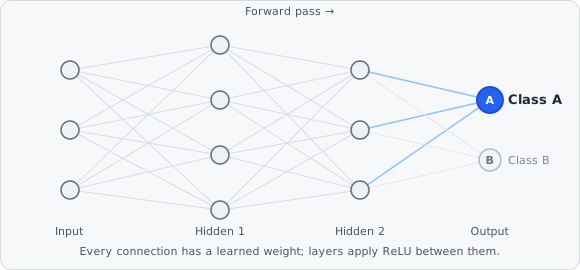
Section titled “How It Works”The network is arranged in layers: an input layer (one node per feature), one or more hidden layers, and an output layer (one node per class). Every node in a layer connects to every node in the next layer, each connection carrying its own weight. A sample is classified with a forward pass:
- Each input node holds one feature value.
- Each hidden node computes a weighted sum of the previous layer’s outputs, then applies a non-linear activation function (ReLU by default) - without this non-linearity, stacking layers would collapse to nothing more than a single linear model.
- The output layer produces one score per class; the highest-scoring node is the prediction.
Training starts from random weights and repeatedly adjusts them: run a batch of labeled samples forward, measure how wrong the predictions were (the loss), then propagate that error backward through the network to nudge every weight slightly toward reducing it (backpropagation, via the Adam optimizer here). One full pass over the training data is an epoch - training runs for a configured number of epochs, hopefully converging to weights that generalize beyond the exact training samples.
Configuring in EVAnalyzer
Section titled “Configuring in EVAnalyzer”| Parameter | Description |
|---|---|
| Hidden Layers | Comma-separated node counts, one entry per hidden layer (e.g. 64, 32 = two hidden layers). More/larger layers can model more complex boundaries, but need more data to avoid overfitting |
| Activation | The non-linearity applied between layers - ReLU, Sigmoid, or Tanh |
| Max Iterations | Number of training epochs (full passes over the training data) |
| Epsilon | Convergence tolerance |
| Learning Rate | Step size the Adam optimizer takes on each weight update. Too high and training oscillates instead of converging; too low and it barely moves |
| Batch Size | Number of samples processed per gradient update |
| Random Seed | Seed for reproducible training runs |
Watch the live per-epoch status banner while training: it reports both training loss and, once there are at least 25 total samples, a held-out validation loss. If validation loss climbs while training loss keeps falling, the network is memorizing the training examples rather than generalizing - see Choosing a Model for what to do about it.
When to Choose It
Section titled “When to Choose It”An MLP can fit more complex, non-linear decision boundaries than a shallow Random Forest or a distance-based k-NN, but it needs a larger and more varied set of labeled examples to do it reliably - with only a handful of painted examples per class, Random Forest will usually generalize better with less tuning. Because training involves gradient descent over real-valued weights, feature scale matters more here than for Random Forest: keep the Feature Channels or Object Metrics you select on roughly comparable scales where possible.