
Canny Edge Detection
The Canny Edge Detection command detects edges by computing image gradients, suppressing non-maximal responses, and applying dual-threshold hysteresis to produce thin, clean edges.
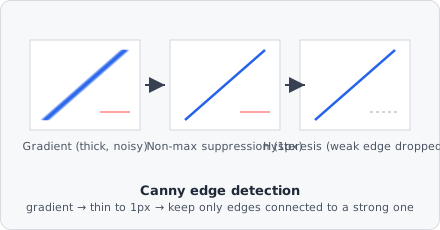
Where Sobel stops at a raw gradient magnitude map (thick, fuzzy bands around every edge), Canny adds two more stages: it thins each band down to its single strongest pixel-wide ridge, then uses two thresholds instead of one - a gradient has to be either strong on its own, or weak but touching a strong neighbour, to survive. Weak, isolated responses (noise) are dropped even if they’d pass a single loose threshold.
When to use
Section titled “When to use”Use Canny when you need precise, thin edge maps. Compared to Sobel, Canny is more accurate but slower. It is well-suited as preprocessing for contour-based segmentation.
Parameters
Section titled “Parameters”| Parameter | Description |
|---|---|
| Kernel size | Size of the Gaussian smoothing kernel applied before gradient computation (range 3–27) |
| Threshold min | Lower hysteresis threshold - edges weaker than this are discarded |
| Threshold max | Upper hysteresis threshold - edges stronger than this are always retained |
Hysteresis thresholding
Section titled “Hysteresis thresholding”Edges with gradient magnitude between the two thresholds are kept only if they are connected to a strong edge (above the upper threshold). This produces cleaner, more continuous edge maps than a single-threshold approach.
A larger kernel size increases smoothing before gradient computation, making the detector less sensitive to fine noise at the cost of detecting coarser edges. As a starting point try kernel_size=3, threshold_min=0.1, threshold_max=0.3.
Background
Section titled “Background”John Canny, “A Computational Approach to Edge Detection,” IEEE Transactions on Pattern Analysis and Machine Intelligence, vol. PAMI-8, no. 6, pp. 679-698, November 1986 - still one of the most-cited papers in computer vision, and the origin of the non-maximum-suppression + hysteresis-thresholding design used here.