
Voronoi
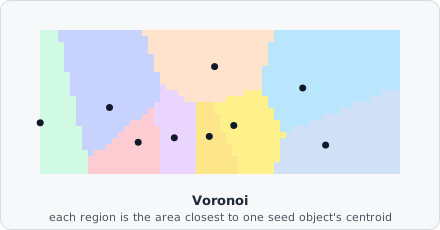
The Voronoi command constructs a Voronoi diagram from the centre points of a set of input objects (the centre of each object’s bounding box). Each Voronoi cell is the region of the image closest to one particular centre point. The resulting cells are stored as objects of the configured output class.
A common use case is approximating cell boundaries from known nucleus positions when no cell-surface stain is available.
Parameters
Section titled “Parameters”| Parameter | Description |
|---|---|
| Centers | Object class whose centre points (bounding-box centres) are used as Voronoi seeds |
| Center filter classes | Additional classes used to refine which centres are included |
| Mask | An optional object class used to clip (intersect) the Voronoi cells |
| Mask filter classes | Additional classes used to refine the clipping mask |
| Output class | Object class assigned to the constructed Voronoi cells |
| Max radius | Maximum radius of a Voronoi cell (disabled if –1) |
| Unit | Size unit for max radius: nm or px |
| Exclude areas at edges | Discard Voronoi cells that touch the image border |
| Exclude areas without centre | Discard cells that do not contain a seed point after masking |
Ties and links
Section titled “Ties and links”A pixel exactly as far from two centres goes to the centre whose object comes first in reading order (further up, then further left), so the cells are the same in every run.
The cells are not linked to the objects they grew from. To get, for example, the nucleus of each cell in the results, add Relate Objects after the Voronoi step.
Max Radius
Section titled “Max Radius”In sparse samples, Voronoi cells can grow arbitrarily large. Setting a Max radius limits cell size to a biologically meaningful maximum. Cells that would exceed the radius are truncated.
Masking
Section titled “Masking”When a Mask class is provided (e.g. a cell-area segmentation), Voronoi cells are intersected with the mask. Any cell area outside the mask is discarded.
Background
Section titled “Background”The Voronoi diagram is named after Georgy Voronoy, “Nouvelles applications des paramètres continus à la théorie des formes quadratiques,” Journal für die reine und angewandte Mathematik, vol. 133, pp. 97-178, 1908, though the concept dates back to Descartes and Dirichlet - it remains one of the most widely used constructions in computational geometry for exactly this kind of “nearest region” partitioning.