
Sobel Edge Detection
The Sobel Edge Detection command computes the gradient magnitude of the image using horizontal and vertical Sobel kernels. Each pixel in the output represents the local rate of intensity change.
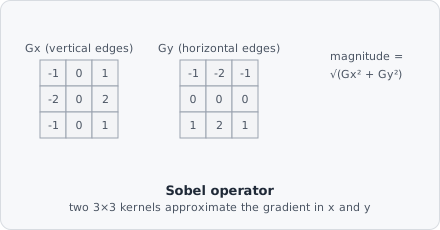
Two small 3×3 kernels approximate the intensity derivative in x () and y () directions independently - combining them with the Pythagorean-style magnitude gives an edge strength that responds to intensity changes in any direction, not just horizontal or vertical ones.
When to use
Section titled “When to use”Sobel is faster and simpler than Canny, making it suitable for real-time preview or as a feature extraction step feeding into a threshold. Edges are broader and less precise than Canny but the computation is significantly faster.
Parameters
Section titled “Parameters”| Parameter | Description |
|---|---|
| Kernel size | Size of the Sobel kernel (range 3–27) |
Larger kernel sizes smooth gradients over a wider neighbourhood before computing the magnitude, reducing noise sensitivity but producing thicker edges.
Background
Section titled “Background”The operator is named after Irwin Sobel and Gary Feldman, who presented it at a Stanford Artificial Intelligence Project talk in 1968 (“A 3×3 Isotropic Gradient Operator for Image Processing”); it was never formally published by the authors but is documented in Sobel’s 2014 retrospective (“History and Definition of the Sobel Operator”) and widely cited via Duda & Hart, Pattern Classification and Scene Analysis (Wiley, 1973).