
Measure Object Shape
Measure Object Shape adds the shape values of CellProfiler’s MeasureObjectSizeShape that objects don’t carry anyway: the convex area and CellProfiler’s solidity, the Euler number, and the radii. Area, perimeter, Feret diameters, axes and the other object metrics are always measured and need no step.
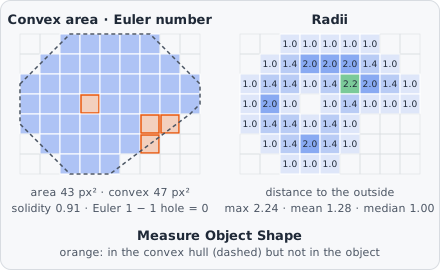
It is a step of its own because the radii need a distance transform of every object, too slow to pay for in every analysis.
Parameters
Section titled “Parameters”| Parameter | Description |
|---|---|
| ID | The step’s ID, unique in the project. Its values’ names in the results start with it (e.g. shape_01). |
| Objects | The objects measured. |
Measurements
Section titled “Measurements”Six values per object:
| Measurement | Unit | Description |
|---|---|---|
| Convex area | px² | The number of pixels whose centre lies in (or on) the object’s convex hull. |
| Solidity (convex area) | 0-1 | Area / convex area. |
| Euler number | - | The number of pieces minus the number of holes; 1 for a solid object. |
| Max radius | px | The largest distance of a pixel to the outside: about the radius of the largest disk that fits in. |
| Mean radius | px | The mean distance of the pixels to the outside. |
| Median radius | px | The median distance of the pixels to the outside. |
How it works
Section titled “How it works”Convex area and solidity
Section titled “Convex area and solidity”The convex hull is taken around the midpoints of the pixels’ edges (the points half a pixel left, right, above and below each pixel’s centre), as scikit-image’s convex_hull_image, which CellProfiler uses. The Convex area is the number of pixels whose centre lies inside or on this hull. It is a pixel count, never smaller than the area.
1 means convex; bays, notches and holes lower it. This solidity matches CellProfiler’s. It differs slightly from the Solidity every object carries, which divides by the area of the hull polygon around the pixel corners. For small objects the two can differ noticeably.
Euler number
Section titled “Euler number”The number of connected pieces minus the number of holes, with pixels connected through their 8 neighbours (so holes through 4). An object is usually one piece, so 1 means no hole, 0 one hole, -1 two holes. It is computed from the 2 × 2 pixel patterns of the mask (Gray’s bit quads), as scikit-image’s euler_number:
with the 2 × 2 windows with one object pixel, those with three, and those with two diagonal ones.
The radius of a pixel is its exact Euclidean distance (from pixel centre to pixel centre) to the nearest pixel that is not part of the object. A pixel on the outline therefore has radius 1. Holes count as outside. The image border does not: the object is measured as if it were surrounded by background. Max, Mean and Median radius are taken over all the object’s pixels; with an even number of pixels the median is the mean of the two middle values.
The Max radius is about the radius of the largest disk that fits into the object, so it gives half the thickness of elongated objects independent of their length.