
k-Nearest Neighbors
k-Nearest Neighbors (k-NN) is one of three algorithms selectable in the Train Classifier dialog, for both pixel and object classifiers. Unlike Random Forest or a neural network, it has no real training step - it classifies a new sample by comparing it directly against every labeled example it was given.
How It Works
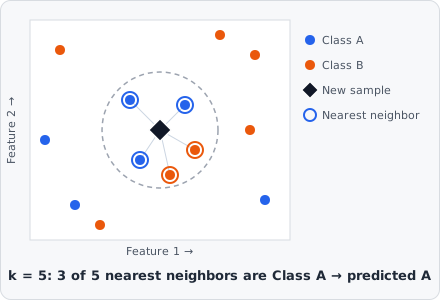
Section titled “How It Works”“Training” a k-NN model just stores every labeled feature vector - there are no weights to fit, no splits to choose. All the work happens at prediction time:
- Compute the distance from the new sample to every stored training example, in feature space (each feature - a Gaussian-blur value, an object’s Circularity, and so on - is one axis of that space).
- Take the k closest examples - the new sample’s nearest neighbors.
- Predict the class that’s most common among them (a majority vote), optionally weighting closer neighbors more heavily than farther ones.
A sample surrounded mostly by Class A examples gets predicted as Class A; the boundary between classes falls wherever neighborhoods change composition, without any explicit rule ever being written down.
Configuring in EVAnalyzer
Section titled “Configuring in EVAnalyzer”| Parameter | Description |
|---|---|
| K (Neighbors) | How many nearest neighbors vote on each prediction. Small k follows local detail (and noise) closely; large k smooths the decision boundary out |
| Distance Metric | How distance between two feature vectors is measured - Euclidean, Manhattan, or Minkowski |
| Search Algorithm | How the nearest neighbors are found - Linear Search checks every stored point; Cover Tree indexes them spatially to skip distant points on larger datasets. Same result either way, just a speed trade-off |
| Vote Weighting | Uniform - every one of the k neighbors counts equally. Distance-weighted - closer neighbors count for more than farther ones |
When to Choose It
Section titled “When to Choose It”k-NN suits classes that form simple, well-separated clusters in feature space - it makes no assumption about the shape of the decision boundary the way a shallow tree or a small network might, so it can follow an irregular boundary closely if you have enough examples near it. Because every prediction re-scans the stored examples, it’s most practical for object classifiers (scoring a moderate number of objects) rather than pixel classifiers (scoring every pixel of every image), where Random Forest or a Neural Network will generally run faster at inference time. Since distance is computed directly on raw feature values, keep an eye on feature scale - a feature spanning 0-1000 will dominate the distance calculation over one spanning 0-1, so it helps to pick features that are already on comparable scales.