
Wavelet Spots
Wavelet Spots enhances spots by combining several levels of detail. The image is split into wavelet planes, from the finest details to coarser ones. A spot stands out of the noise at several levels at once, noise only at one - so the product of the levels keeps the spots and drops the noise. The result is positive at bright spots and exactly 0 everywhere else (background, dark spots, what stands out at one level only). It follows Olivo-Marin (2002).
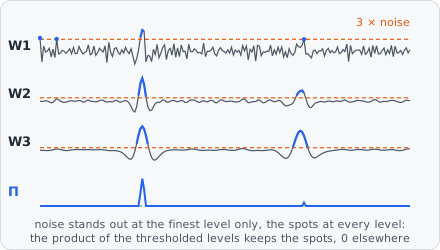
A typical spot pipeline:
Wavelet Spots → Find Maxima → Extract Objects
It is a preprocessing step: its result replaces the image for the steps after it. Measure intensities on the original channel, not on this image. In a project file it is WAVELET_SPOTS.
When to use
Section titled “When to use”For small spots on a noisy background, especially when the spots are not all of one size (up to about 2^Levels px). It needs no spot size, only how many levels to combine, and its noise threshold adapts to each image. For spots of one known size, Laplacian of Gaussian or Difference of Gaussians are the simpler choice.
Since everything that is not 0 already stands out at every combined level, Find Maxima with Cutoff Manual and Min Quality 0 keeps every spot; raise Min Quality to keep only the stronger ones (the paper’s detection level).
Parameters
Section titled “Parameters”| Parameter | Description |
|---|---|
| Levels | How many levels are computed: 2, 3 (default), 4 or 5. Level i holds details of about 2^i pixels, so 3 suits spots up to about 8 px. |
| First Level | The finest level that is combined; the levels below it are skipped. Level 1 is mostly noise: 2 gives fewer false spots for spots of 4 px and more. Default 1 (the paper), range 1-5, at most Levels. |
| Noise Factor | A level counts at a pixel only where it is at least this many times its noise; 3 in the paper. Default 3, range 0-20. |
| Noise | (advanced) How the noise of each level is estimated. Per Level (default, the paper): from each level on its own - where spots or other structures fill much of the image, the coarser levels count them as noise and their threshold rises. Finest Level: from the finest level, which holds the least structure, scaled to the other levels as Gaussian noise passes through the transform - steadier with many spots or a structured background. |
| Output | The unit of the result. Product (default): the paper’s product of the combined levels, the image’s intensities to the power of their number. Intensity: its geometric mean (the product’s m-th root, m the number of combined levels) - the same spots and maxima in the image’s units, so Find Maxima’s cut-off and prominence don’t change with the number of levels. |
How it works
Section titled “How it works”- À trous transform (Starck & Murtagh 1994; Olivo-Marin 2002, sect. 2): is the image; is smoothed with the B3-spline kernel whose taps lie pixels apart, mirrored at the borders. The wavelet plane of level is , for to Levels.
- Thresholding (sect. 3): is kept where and set to 0 elsewhere, with = Noise Factor. Noise Per Level: , the median absolute deviation of (the paper). Finest Level: so, and , with the noise of plane for white noise of standard deviation 1 (the norm of the plane’s impulse response; Starck & Murtagh scale the noise to the planes the same way).
- Product (sect. 3): the result is of the thresholded planes, for = First Level to Levels. With Output Intensity it is , the number of combined levels.
With Output Product its values are the image’s intensities to the power of , so they differ greatly from the image’s values; with Intensity they are in the image’s units. The paper’s last step, keeping above a detection level, is left to Find Maxima’s cut-off.
Limitations
Section titled “Limitations”- 2D only: each plane is filtered on its own.
- Dark spots are not found: the result is 0 for them.
- On a whole slide the filter runs per tile, mirrored at the tile’s borders, and the noise of each level is measured per tile. Small images are one tile and not affected.
References
Section titled “References”- Olivo-Marin J.-C., “Extraction of Spots in Biological Images Using Multiscale Products,” Pattern Recognition, vol. 35, pp. 1989-1996, 2002. doi:10.1016/S0031-3203(01)00127-3
- Starck J.-L. & Murtagh F., “Image Restoration with Noise Suppression Using the Wavelet Transform,” Astronomy and Astrophysics, vol. 288, pp. 342-348, 1994. ADS
The step cites both; see Citation for exporting the citations of a project.