
Difference of Gaussians
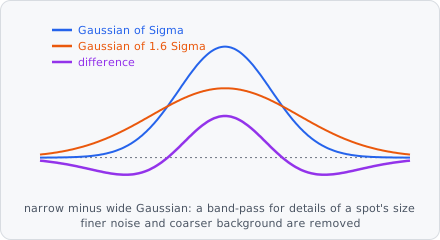
Difference of Gaussians (DoG) enhances spots of one size: a slightly blurred copy of the image minus a more blurred one keeps the details of a spot’s size and removes finer noise and coarser background and structures. Bright spots become positive peaks, dark spots negative ones, and flat background becomes 0.
A typical spot pipeline:
Difference of Gaussians → Find Maxima → Extract Objects
It is a preprocessing step: its result replaces the image for the steps after it. Measure intensities on the original channel, not on this image. In a project file it is DIFFERENCE_OF_GAUSSIANS.
When to use
Section titled “When to use”As Laplacian of Gaussian: to find small spots of about one size on an uneven background. The DoG approximates the LoG and gives values in the same units, so a Find Maxima cut-off found for one works for the other. For objects of different sizes, use Bandpass, where both σ are free.
Parameters
Section titled “Parameters”| Parameter | Description |
|---|---|
| Sigma | The scale σ of the spots to enhance - the narrower Gaussian; the wider one is 1.6 σ. As a guide, σ ≈ spot radius / √2 (1.4 for spots of 4 px radius). Smaller details count as noise, larger ones as background. Default 1.5, range 0.1-1000. |
| Unit | Unit of Sigma: px (default) or nm. Without a pixel size, nm are taken as pixels. |
How it works
Section titled “How it works”The image is smoothed with the discrete Gaussian (Lindeberg 1998, appendix A.4.1) at σ and at 1.6 σ, and the result is
The ratio 1.6 is the narrowest band-pass that still keeps the filter sensitive (Marr & Hildreth 1980, appendix B). Since (Lowe 2004, sect. 3), dividing by gives the units of the scale-normalized Laplacian of Gaussian, with bright spots positive.
Limitations
Section titled “Limitations”- 2D only: each plane is filtered on its own.
- On a whole slide the filter runs per tile, mirrored at the tile’s borders like Gaussian Blur. Small images are one tile and not affected.
References
Section titled “References”- Marr D. & Hildreth E., “Theory of Edge Detection,” Proceedings of the Royal Society of London. Series B, vol. 207, pp. 187-217, 1980. doi:10.1098/rspb.1980.0020
- Lowe D. G., “Distinctive Image Features from Scale-Invariant Keypoints,” International Journal of Computer Vision, vol. 60, pp. 91-110, 2004. doi:10.1023/B:VISI.0000029664.99615.94
- Lindeberg T., “Feature Detection with Automatic Scale Selection,” International Journal of Computer Vision, vol. 30, pp. 79-116, 1998. doi:10.1023/A:1008045108935
The step cites all three; see Citation for exporting the citations of a project.