
Vesselness
Vesselness turns the image into a map of how much each pixel looks like the middle of a line - a fibre, neurite or vessel - of the widths you give. The result is 0 to 1: high in the middle of a line, low for the background, blobs and flat areas. It follows Frangi et al.’s multiscale vesselness filter.
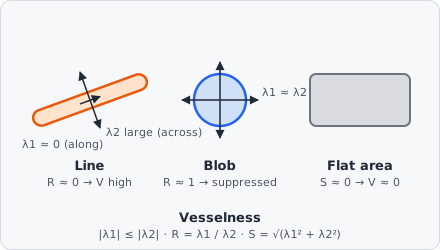
Use it before a Threshold to segment thin fibres that a threshold on the raw image can’t separate from the background, for example:
Vesselness → Threshold → Connected Components → Extract Objects → Skeletonize Objects
It is a preprocessing step: its result replaces the image for the steps after it. In a project file it is VESSELNESS.
Parameters
Section titled “Parameters”| Parameter | Description |
|---|---|
| Min Width | The width of the thinnest lines to find (0.5 to 1000, default 2). |
| Max Width | The width of the widest lines to find (0.5 to 1000, default 6). |
| Width Steps | How many widths from the thinnest to the widest are tried, spaced evenly on a log scale (1 to 10, default 3). More: a steadier response over the widths, but slower. |
| Width Unit | Unit of the widths: px (default) or nm. |
| Polarity | Bright lines on a dark background (fluorescence, default) or Dark lines on a bright one (brightfield). |
| Blob Suppression | Advanced. How strongly blobs are suppressed (Frangi’s , 0.05 to 5, default 0.5). Lower suppresses more, so only clearly elongated structures stay. |
| Noise Level | Advanced. Structures much weaker than this count as noise (Frangi’s , on the 0-1 scale of the image’s second derivatives, default 0). 0: automatic, half the strongest structure. |
How it works
Section titled “How it works”Widths and scales
Section titled “Widths and scales”Each width is turned into a Gaussian scale
the scale at which the response to a bar of that width peaks (a bar of width has the spread , and the response to a line of spread peaks at ). The Width Steps widths are spaced evenly on a log scale from Min Width to Max Width; with one step only Min Width is used. The defaults (2 to 6 px, 3 steps) give the widths 2, 3.46 and 6 px. Widths in nm are divided by the pixel size (the mean of its x and y size); without a pixel size they are taken as pixels.
Vesselness at one scale
Section titled “Vesselness at one scale”At each scale the Hessian of every pixel is computed: the second derivatives of the image smoothed with a Gaussian of , multiplied by so that the scales compare. The Gaussian and its derivatives are cut off at ; at the image border the edge pixels are repeated outward.
The Hessian’s two eigenvalues are sorted so that . On a line, (along it) is small and (across it) is large - negative for a bright line, positive for a dark one. From them:
is near 0 for a line and near 1 for a blob; is the strength of the structure, small for flat areas and noise. The vesselness is
with = Blob Suppression and = Noise Level. is 0 where has the wrong sign for the Polarity (for Bright: ; for Dark: ), so lines of the other polarity are not found.
With Noise Level 0, is half the largest in the image at that scale (Frangi’s suggestion). A flat image, where even the largest is below , stays 0.
Result
Section titled “Result”The result is the largest of each pixel over all scales, from 0 to 1. To threshold it, the Threshold unit Relative (0-1) takes the vesselness values directly.
The method is from A. F. Frangi, W. J. Niessen, K. L. Vincken and M. A. Viergever, “Multiscale Vessel Enhancement Filtering,” Medical Image Computing and Computer-Assisted Intervention (MICCAI’98), 1998, pp. 130-137, doi:10.1007/BFb0056195.
Limitations
Section titled “Limitations”- 2D only: each plane is filtered on its own.
- At its centre a blob answers far less than a line, but its rim looks like a curved line at the smallest scale and does answer - Frangi’s known behaviour.
- On a whole slide the filter runs per tile, without overlap: with Noise Level 0 each tile gets its own automatic level, so neighbouring tiles can be scaled slightly differently, and the image edge is repeated at every tile border. A fixed Noise Level gives the same scaling on every tile. Small images are one tile and not affected.